•

The Architects Shaping St Barth: A Guide to Three Local Practices
Three local practices, one island, a common conversation. A guide to François Pecard, Bruneau Ghezzi Architectes, and Johannes Zingerle's Design Affairs, the architects shaping contemporary St Barth.
Jun 19, 2026•jessica schmidt
From François Pecard's vernacular pavilions to Bruneau Ghezzi's bioclimatic compositions and Johannes Zingerle's contemporary signatures, three architecture practices have shaped how St Barth builds today. A complete guide by Hamaka.
St Barth has always built carefully. The island's eight square miles of volcanic rock, sun-bleached vegetation, and steep coastline impose their own discipline. Hurricanes pass through. The trade winds shape every roofline. Sunsets dictate where you place a window.
For decades, the result was a coherent vernacular. Small, modest houses of wood and stone, oriented to the breeze, tucked into the hillsides. The traditional case, a single-room dwelling, raised on stilts, with a low-pitched roof, set the grammar. It was a language that asked little of the land, and gave back to it more than it took.
Over the past four decades, that grammar has been reinterpreted, expanded, and at times redrawn entirely. A new generation of clients, collectors, founders, second-home seekers from New York, Paris, and São Paulo, brought larger ambitions to the island. The architects who could meet those ambitions while still listening to the land became the authors of a recognisable contemporary St Barth style.
Three local practices, in particular, have shaped the conversation. François Pecard, the longest-standing voice on the island, has spent forty-five years refining a vernacular language adapted to natural sites. Bureau Bruneau Ghezzi Architectes, the most influential of the new generation, works under a philosophy they call "Augmented Nature." And Design Affairs, led by Vienna-trained Johannes Zingerle, has become the contemporary signature most recognised in international design press, from Architectural Digest to The Wall Street Journal. This guide walks through their work, what each practice stands for, where to see it, and what together they reveal about how St Barth thinks about building today.
François Pécard: The Vernacular Master
François Pécard has been designing on St Barth for forty-five years. That fact alone matters. Only a handful of architects on the island can claim to have watched it grow from a quiet French outpost into the most discreet luxury destination in the Caribbean, and to have built throughout. His practice, based in Gustavia, has accompanied the transformation without ever leaving the language of the island.
His architecture, today, looks as if it had always been there. That is the discipline that defines his work.
Pécard articulates the principle himself with a clarity that has not aged. As stated on his studio's official site, the practice is built on "the multiplication of small volumes, implanted on the site according to the natural elements, wind, sun, relief, vegetation, allowing for a perfect integration into the landscape, and authorising an evolution of the construction according to the needs and means of the users."
What sounded forty-five years ago like a regional sensibility now reads as something else entirely: a contemporary credo. The retreat from the single, dominant volume. The refusal to flatten a plot. The acceptance that a house can grow over time. These are the questions every serious architect working in fragile landscapes is asking in 2026, and Pecard has been asking them since the early 1980s.
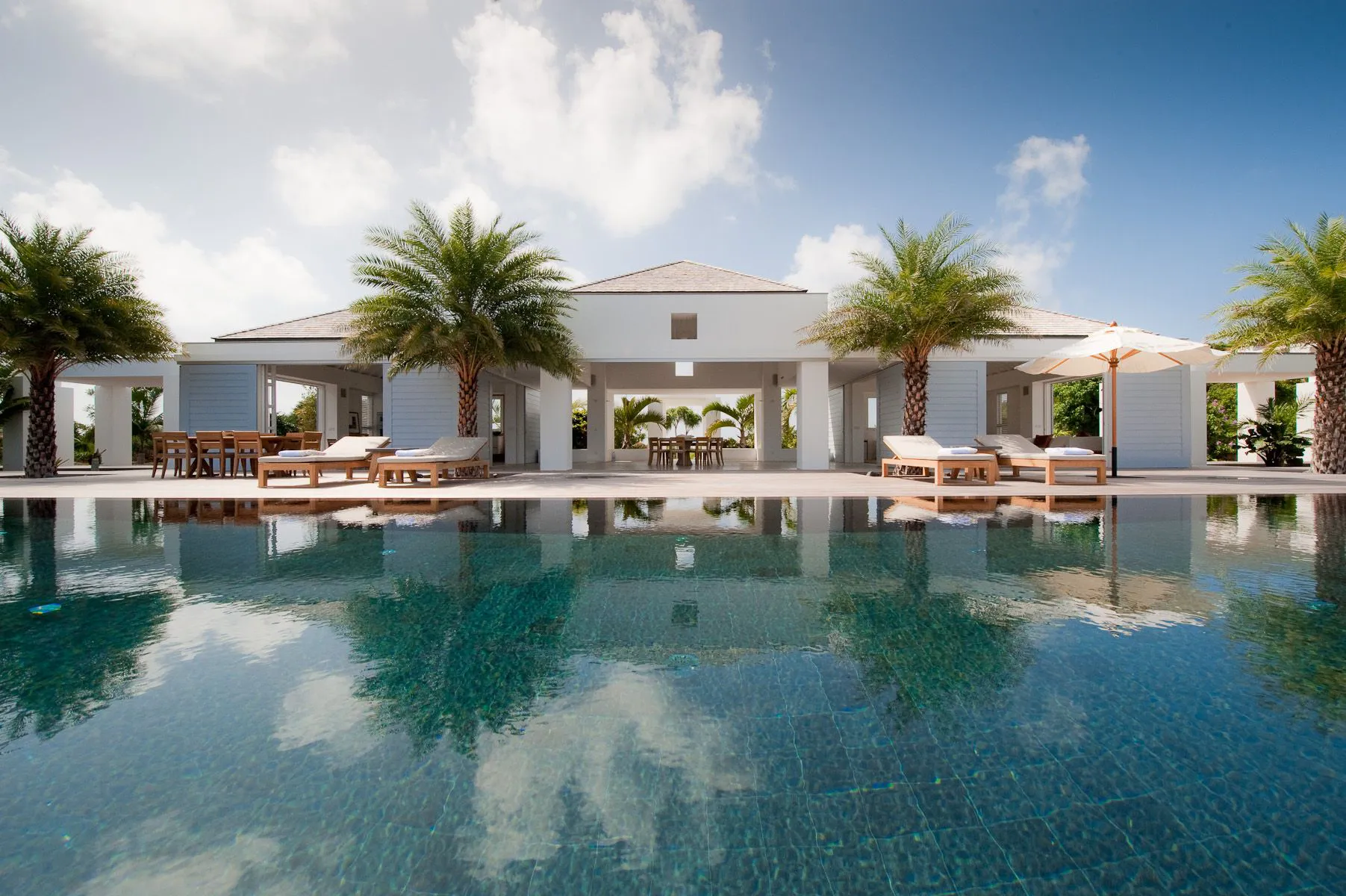
His portfolio illustrates the principle. Boutique Hermès in Gustavia, discrete, tucked, never asserting itself against the harbour. Restaurant L'Isola, the island's most refined Italian table, set within an architecture that lets the meal occupy the foreground. These institutional projects have anchored his legitimacy as the island's longest-serving architect, and they continue to shape the daily visual register of Gustavia.
Among Hamaka's curated homes, three Pecard villas illustrate his approach with particular clarity: Villa Olive, Villa Jasmine, and Villa BOM. Each is built around the rule of small connected volumes rather than a single sprawling structure. Each leaves the vegetation more or less where it was found. Each can, in principle, accept a new pavilion in ten or twenty years without losing its original logic.
That last point is rarely mentioned in luxury architecture, but it is a definition of restraint that has aged remarkably well. Where many contemporary villas read as final statements, sealed and complete on the day of their delivery, a Pécard house is composed to live with its inhabitants and to evolve with them. It is, in the most quiet sense of the word, a sustainable architecture, written long before the term entered the vocabulary of luxury.
Bureau Bruneau Ghezzi Architectes: Augmented Nature
If Pecard is the memory of St Barth's architecture, Bureau Bruneau Ghezzi is its most articulate contemporary voice. Founded by Yannick Bruneau and Jérémie Ghezzi, the practice has spent more than a decade refining a position the founders themselves call Augmented Nature, a phrase that captures, with deliberate care, the tension at the heart of their work.
The architecture they design is unmistakably contemporary in its materials, its lines, and its ambitions. But it is offered as a continuation of the landscape, not as a counterpoint to it. As the studio states on its own website, the practice draws on "local cultures and ways of living, reinterpreting traditions while adapting to each context," with an expertise rooted in Saint-Barthélemy that extends internationally.
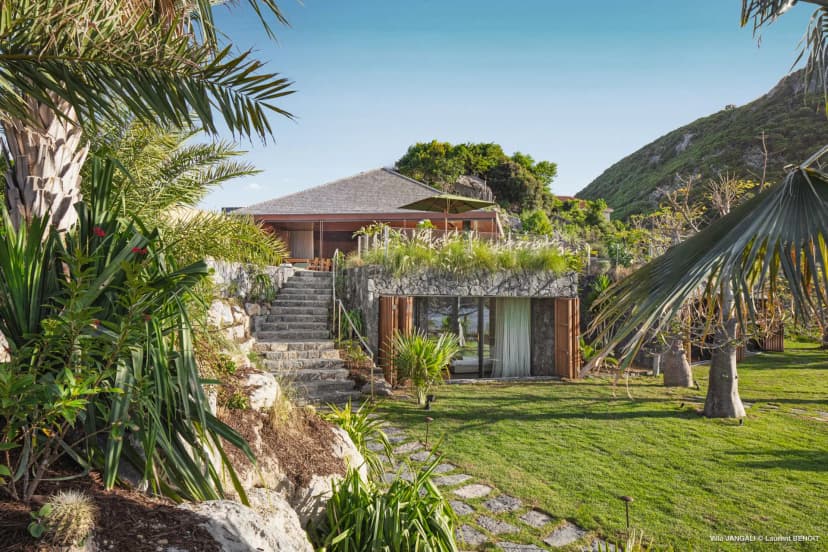
The most quietly radical project in their portfolio is also their best known: Villa Jangali, completed at the tip of Petite Anse, in collaboration with the celebrated Brazilian architect Isay Weinfeld. The brief was demanding. Seven thousand square feet of program, on a fragile coastal site, with strict local protections.
The response was extraordinary: to bury over seventy percent of the construction. Vertical circulation organises the volumes along a single axis, taking advantage of the thermal inertia of the buried masses to reduce air-conditioning needs to a minimum. The entrance is a stone cave leading to an underground garage. The remainder of the villa unfolds upward, opening to the sea only at the moments where the architects decided it should.
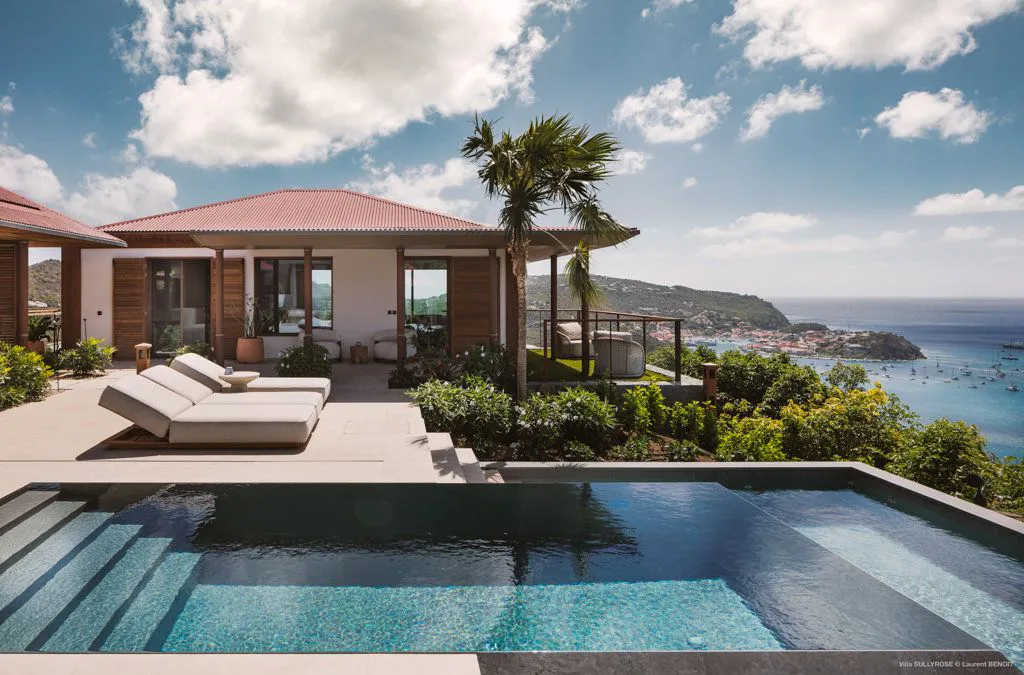
Weinfeld brought the international signature to the project. Bruneau Ghezzi made it possible on St Barth, navigating the local codes, supervising the execution, and adapting the design to the site's many constraints. The collaboration is also a model: international vision, local intelligence, both required. Our dedicated essay on Villa Jangali explores the project in greater depth.
Beyond Jangali, the practice's St Barth signature has continued. Villa Maison SullyRose, on the heights of Colombier, develops the same vocabulary at a different elevation. Two heated infinity pools, panoramic outlooks over Gustavia harbour, noble materials, lines that remain clean and quietly luminous. Villa June, another recent project, completes the local trilogy.
Johannes Zingerle / Design Affairs: The Contemporary Voice
If Pécard is memory and Bruneau Ghezzi is articulation, Johannes Zingerle is exposure. The Vienna-trained architect, who divides his practice between St Barth and Miami, has become the contemporary signature most recognised in the international design press. Architectural Digest has published his work across its France, Italia, and Middle East editions. The Wall Street Journal has covered his most prominent recent sale, Villa Never Say Never in Lurin, listed in November 2024 at one of the island's highest hilltop figures. His firm, Design Affairs, has shaped the way St Barth is photographed for design audiences.
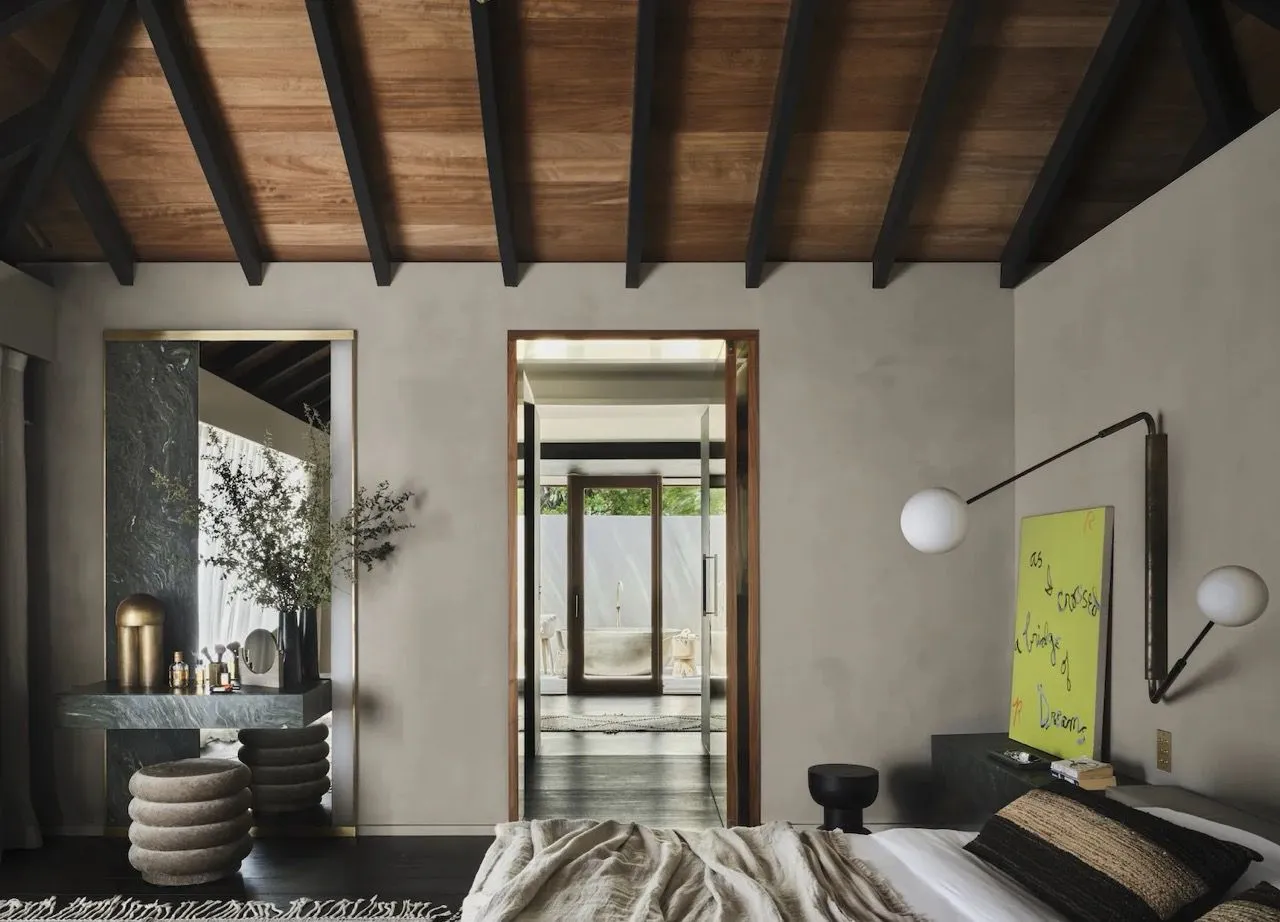
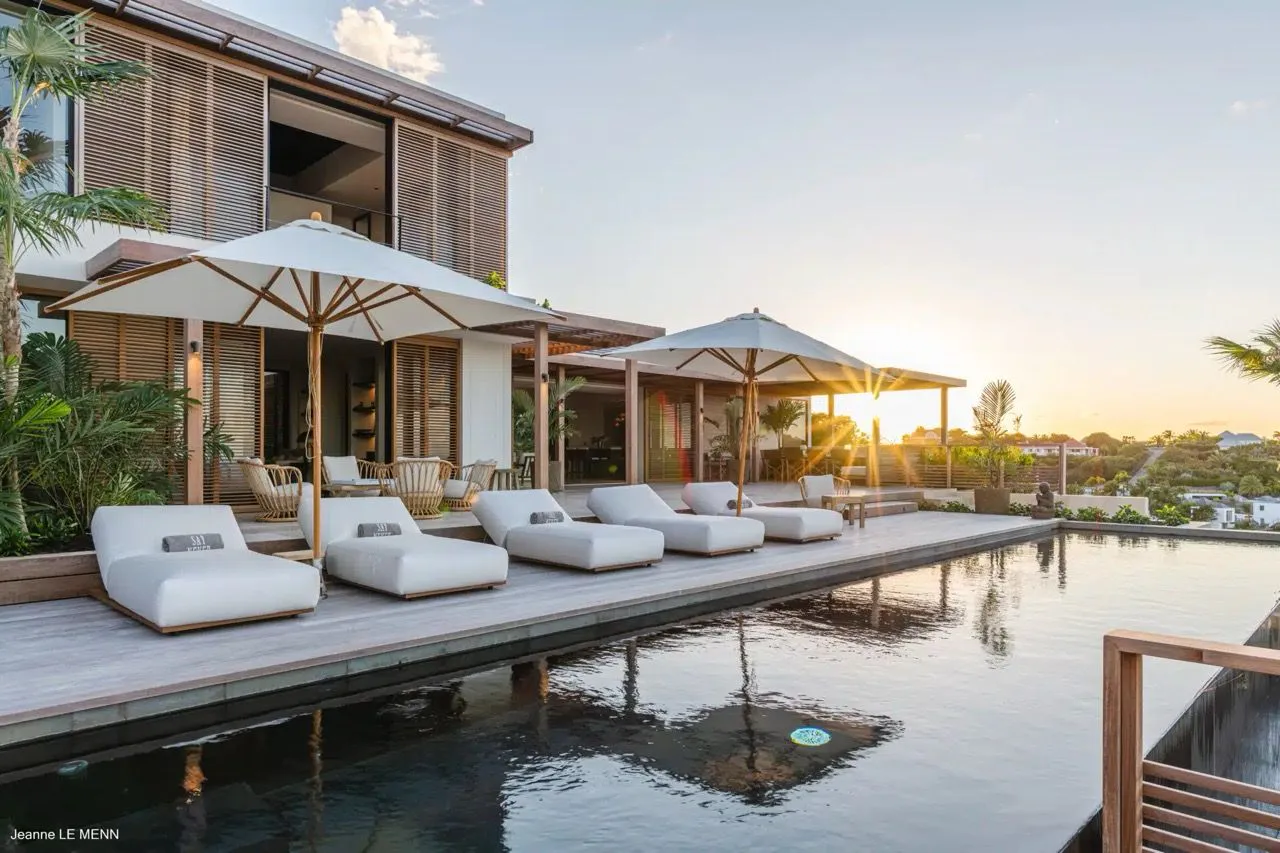
The Zingerle aesthetic is identifiable from the first frame. Straight lines. Quiet greys against warm natural woods. Sliding panels that conceal audiovisual technology, bars, even drawers without visible handles. The villas open themselves on demand and close themselves again when discretion is needed. Architectural Digest described his approach, in a 2022 portrait, as a study in contemporary restraint applied to a tropical climate, and the description still holds. The most recent Zingerle villa to enter the Hamaka collection is Villa Ohana, in Saint-Jean. Featured across multiple AD editions, including a recent feature in AD France titled "Un domaine paradisiaque sur l'île de Saint-Barth", the home was conceived for collectors. The villa's interiors were developed by Alexander Design in Los Angeles. The result is a glamorous compound of two villas overlooking Saint-Jean Bay, where Zingerle's spatial composition meets a deeply rich, art-forward, intensely coloured palette. It is one of the most photographed houses on the island, and it is now accessible through Hamaka.
Three additional Zingerle projects sit in the Hamaka portfolio. Villa Never Say Never, currently available for both rental and sale, demonstrates the architect's mastery of hilltop sites — an infinity pool oriented to the horizon, four bedrooms, sweeping views of Gouverneur Beach and the airport runway below.
Villa Palm Beach, on the sand at Anse des Cayes, was rebuilt under Design Affairs's direction over eighteen months. A renovation in which the pool was extended by six metres, the concrete façades were re-clad in iroko and IP wood, and a pergola was added without disturbing the original lines. Each project reads as a chapter in the same conversation.
A fourth, Villa The Peak, completed in 2009 in collaboration with art director Wolfgang Ludes, remains off-market. The project is publicly documented by the Atelier de Yavorsky's design consulting archives, with photographs by Jean Philippe Piter, a testament to its early importance in the formation of Zingerle's St Barth vocabulary.
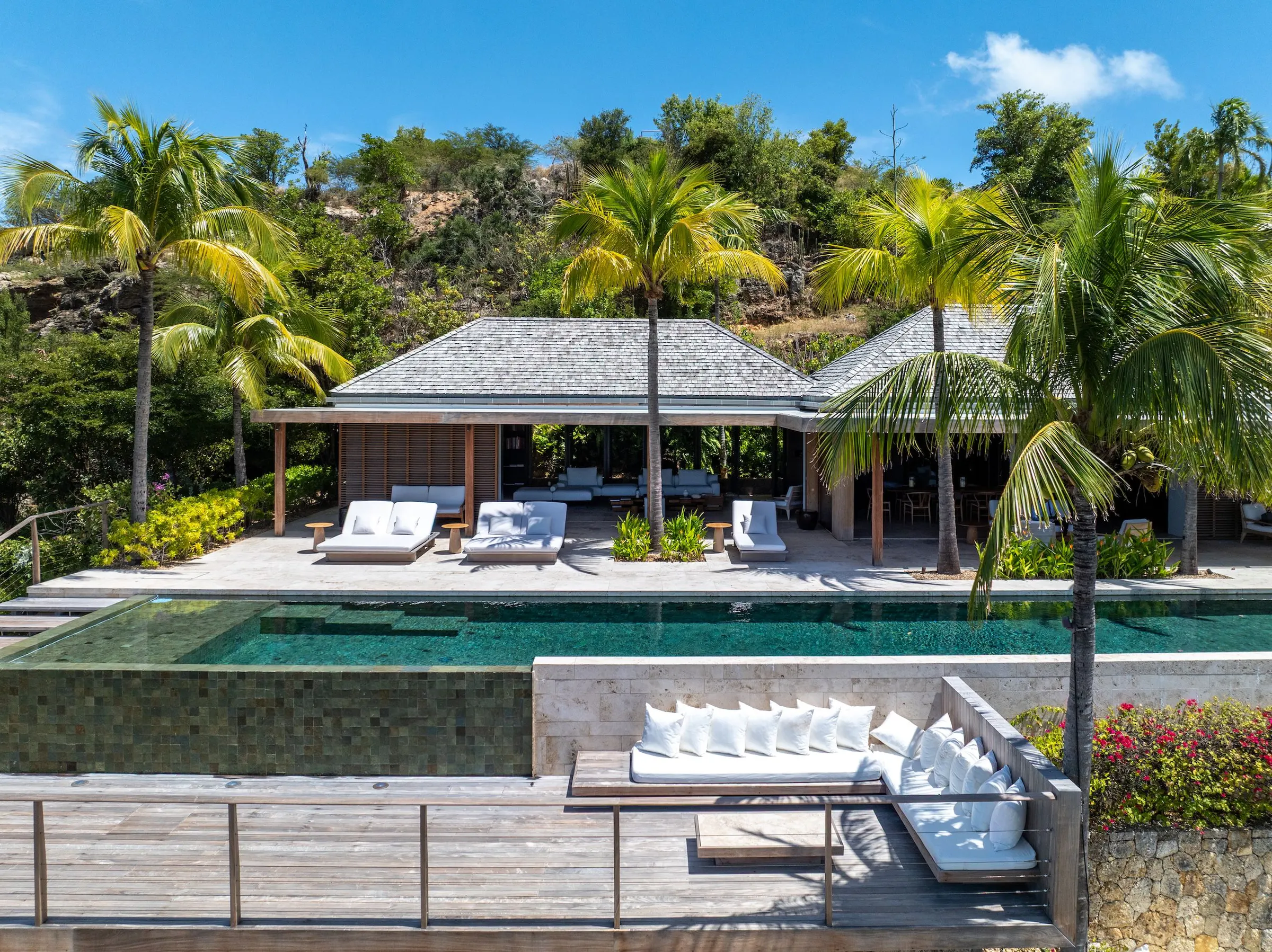
Other Zingerle works on the island, including Villa La Pausa, are not available for rent but extend the body of work that has made Design Affairs the island's most internationally visible practice. Each of them carries the same disciplined neutrality, the same patient attention to materiality, the same intuition that the most ambitious contemporary villa in the Caribbean today is the one that knows how to remain quiet.
A Caribbean Conversation: What They Share, What Sets Them Apart
Read alongside one another, the three practices reveal more than three styles. They reveal a common conversation about what building on St Barth means.
All three accept the same starting premise: the island is not a blank site. It has wind patterns, sun lines, vegetation, slopes, codes, and decades of houses that already exist. To build well is to begin from what is already there. All three refuse the easy gesture — the dominant volume, the visual statement, the architecture that exists to be photographed first and inhabited second. And all three work in materials that age in conversation with the climate: stone, wood, lime, plaster.
Where they differ is in the language they have developed inside this shared discipline. Pecard speaks the vernacular, the multiplied small volume, the evolving footprint, the deep continuity with what the island has always built. Bruneau Ghezzi speaks the bioclimatic, the buried mass, the augmented nature, the thermal logic of a contemporary structure rooted in the ground. Zingerle speaks the contemporary refined, the long horizontal line, the concealed mechanism, the disciplined neutrality that lets light and material do the work.
Where to Experience Their Work: A Hamaka Guide
The work of these three practices is unusually accessible. Several of their most accomplished homes are available for stay through Hamaka, not, in most cases, advertised publicly elsewhere.
Pecard's island. To see François Pecard's vernacular at scale, three villas in the Hamaka collection illustrate the principle of multiplied small volumes: Villa Olive, Villa Jasmine, and Villa BOM. Each is built across separate pavilions rather than as a single mass. For visitors not staying in a Pecard home, two public projects on the island offer a daytime introduction: the Boutique Hermès in Gustavia, and the dining room of Restaurant L'Isola.
Bruneau Ghezzi's island. The practice's signature is fully on display in three Hamaka homes: Villa Jangali at Petite Anse (in collaboration with Isay Weinfeld), Villa Maison SullyRose in Colombier, and Villa June. For those interested in the architectural language specifically, Villa Jangali — with its largely buried structure, its troglodyte logic, and its bioclimatic rigour — is the most complete demonstration of Augmented Nature in built form.
Zingerle's island. The Design Affairs portfolio is the most international in the Hamaka collection. Villa Ohana in Saint-Jean, featured across Architectural Digest's France, Italia, and Middle East editions, is the most photographed of the practice's recent St Barth work. Villa Never Say Never in Lurin, currently available for both rental and sale, demonstrates Zingerle's command of hilltop sites. Villa Palm Beach on Anse des Cayes shows the architect's mastery of renovation. A fourth project, Villa The Peak, remains off-market but is available on private request.
For guests planning a stay, Hamaka's conciergerie can map a curated itinerary that includes architectural visits, private moments at each villa, and selected meetings with the studios themselves where requested. The island, read through its architecture, becomes another island entirely.
Frequently Asked Questions
Who are the most important architects working in St Barth?
Three local practices have shaped the contemporary architecture of St Barth: François Pecard, who has worked on the island for forty-five years in a refined vernacular style; Bureau Bruneau Ghezzi Architectes, founded by Yannick Bruneau and Jérémie Ghezzi, known for their "Augmented Nature" philosophy; and Design Affairs, led by Vienna-trained Johannes Zingerle, whose contemporary work has been featured across Architectural Digest's France, Italia, and Middle East editions.
Who designed Villa Jangali in St Barth?
Villa Jangali, at Pointe de Petite Anse in Flamands, was designed by the renowned Brazilian architect Isay Weinfeld in collaboration with the local firm Bruneau Ghezzi Architectes. Over seventy percent of the construction is buried, taking advantage of the thermal inertia of the surrounding mass, a bioclimatic approach that defines the practice's signature.
What is the architectural style of a typical luxury villa in St Barth?
There is no single style. The island's contemporary architecture has developed across three main directions: a refined vernacular (small multiplied volumes integrated into natural sites), a contemporary bioclimatic approach (buried structures, thermal mass, natural ventilation), and a refined modernist sensibility (long horizontal lines, concealed technology, neutral palettes). What unites them is a discipline of integration: the architecture begins from the site rather than imposing upon it.
Can I rent an architect-designed villa in St Barth?
Yes — and several of the island's most accomplished architect-designed villas are accessible through Hamaka. The collection currently includes nine villas signed by the three leading local practices: three by François Pecard (Villa Olive, Villa Jasmine, Villa BOM), three by Bruneau Ghezzi (Villa Jangali, Villa Maison SullyRose, Villa June), and three by Johannes Zingerle / Design Affairs (Villa Ohana, Villa Never Say Never, Villa Palm Beach).
Where can I see the work of Design Affairs / Johannes Zingerle outside a private villa?
Johannes Zingerle's work has been published in Architectural Digest (France, Italia, Middle East), The Wall Street Journal, and Sibarth's villa portfolio. Several of his completed projects are off-market or privately owned. For guests staying with Hamaka, the conciergerie can arrange architectural visits where appropriate, including, on request, a private viewing of Villa The Peak (2009), a Design Affairs project documented by Atelier de Yavorsky.